
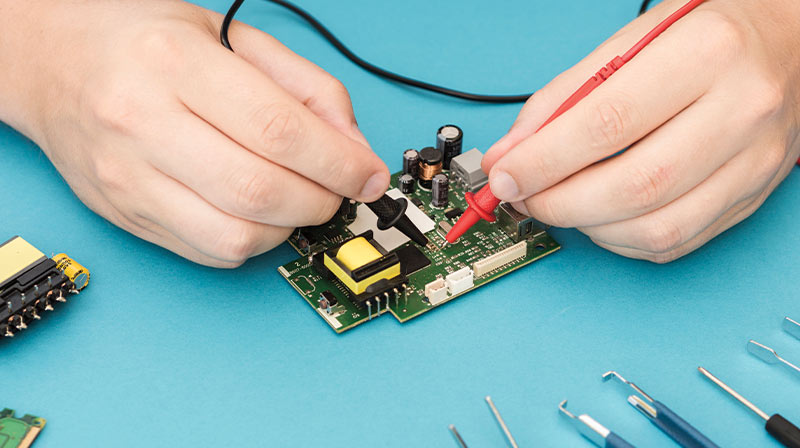
PCB board assembly issues often originate before assembly
Most PCB board assembly failures are not caused by the pick and place machine or reflow oven. They are embedded long before the first component lands on the board. Problems like tombstoning, pad cratering, solder bridging, or BGA head in pillow often stem from decisions made during stack up design, material selection, or fabrication. Yet many engineering teams treat PCB fabrication and assembly as disconnected phases, if if a board passes electrical test, it is ready for SMT. That assumption invites yield loss, rework, and field reliability issues that only appear after thousands of units are built.
The root cause usually lies in overlooked interactions between physical board properties and the thermal and mechanical stresses of assembly. A microvia not filled per IPC 4761 Type VII may pass continuity test but trap flux during cleaning. A solder mask defined pad on a high Tg laminate might look fine visually but create inconsistent wetting due to uneven copper exposure. These are not assembly errors. They are latent defects enabled by upstream gaps.
This article reveals how common PCB board assembly issues originate in preassembly stages, from Gerber release to bare board delivery, and what buyers and designers can do to catch them early. It covers material mismatches, fabrication tolerances, and documentation gaps that silently sabotage even the most advanced SMT lines.
Why the Fab to Assembly Handoff Is the Weakest Link in Electronics Manufacturing
In theory, a finished PCB is a blank canvas for assembly. In practice, it is already loaded with hidden constraints or risks based on how it was built. The handoff from PCB fabrication to PCBA is where assumptions replace verification. The assembler trusts the fab met IPC 6012 Class 2. The buyer assumes the stack up matches the impedance calculator output. But small deviations, like 10 percent higher Z axis CTE or 2 mil solder mask misregistration, can cascade into major assembly defects.
Consider thermal expansion. If the laminate Td, or decomposition temperature, is below the peak reflow temp of SAC305, which is around 245 degrees Celsius, the resin degrades during soldering, weakening interconnects. Or take the surface to finish. Immersion silver applied over rough copper increases contact resistance and accelerated tarnishing, leading to poor wetting days after receipt. None of these show up in a bare board continuity test, but all directly impact assembly yield.
Without integrated process ownership, these risks go unaddressed until AOI flags a pattern of cold joints, or ICT shows intermittent opens. By then, the cost to fix is not just rework. It is delayed product launch and eroded customer trust.
Problems That Start Long Before the First Component is Placed
It’s easy to blame the assembly line when defects show up. But often, the real cause was locked into the board during design or fabrication. A board can pass all electrical tests and still be set up to fail during soldering—not because of machine error, but because key details were missed or misaligned between teams.
For example, a high-speed PCB built with standard FR 4 desmear might look perfect coming off the fab line. But if the design needed plasma treatment for reliable BGA via wetting, that mismatch won’t surface until reflow—and by then, thousands of units could be affected. The fab followed its process. The assemblers followed theirs. But no one connected the dots on material behavior under real assembly conditions.
Another common issue shows up with small passives. A slight increase in solder mask thickness—still within the fab’s tolerance—can shrink the exposed copper just enough to upset the balance of surface tension during reflow. The result? Parts stand up on one end. It’s not a placement problem. It’s a pad definition problem that went unnoticed because mask thickness wasn’t reviewed in the context of the actual paste and thermal profile.
These failures aren’t random. They happen when critical handoffs lack shared context:
- When stack up choices aren’t checked against the reflow temperature curve
- When finish type is selected without considering shelf life and flux chemistry
- When fiducial contrast isn’t tested under the same lighting the AOI system uses
- When panel design doesn’t account for how the board will be depanelized
The truth is that a board is not “assembly ready” just because it powers up. It is ready only when every layer, every material, and every feature has been validated against the real conditions it will face on the SMT line. Without that alignment, even the best assembly team is working with hidden risks.
How Material and Documentation Gaps Sabotage Even Expert Assembly Teams
A world class SMT line cannot compensate for bad inputs. If the bare board arrives without a full material declaration, including Tg, Td, Z axis CTE, Dk and Df, and MSL rating, the assembler is flying blind. They cannot validate reflow profiles, baking cycles, or storage conditions without knowing the board’s thermal limits.
Similarly, missing or inconsistent documentation creates guesswork. Does the netlist match the latest revision? Are back drill depths called out for high speed vias? Is the finish ENIG or ENEPIG, which is critical for wire bondability or RF performance? Without a single source of truth, assemblers make assumptions that may be technically reasonable but wrong for the specific design.
Worse, some fab houses omit critical process notes, such as whether microvias were plasma cleaned or if resin was cured per spec. These steps affect adhesion and outgassing but leave no visible trace. Only when the board fails thermal cycling or humidity testing does the root cause emerge, and by then, the fab may deny responsibility.
Preventing Assembly Failures Starts with Upstream Accountability
The most reliable PCBA outcomes come from treating fabrication and assembly as one continuous process, not two handoffs. Integrated manufacturers run joint DFM reviews where stack up choices are validated against actual reflow profiles, and via structures are checked for compatibility with cleaning and coating steps.
They also enforce strict incoming inspection protocols, measuring solder mask thickness, verifying finish thickness via XRF, checking bow and twist per IPC TM 650 2.4.22, and validating panel fiducial accuracy before loading the line. This is not extra work. It is risk prevention.
For buyers, the key is to demand transparency. Ask for full material datasheets, IPC compliance certificates, not just ISO 9001, and process flow documents that include lamination cycles, final bake steps, and electrical test methods. If a vendor hesitates, that is a red flag, not a cost saver.
Final Word
PCB board assembly does not start when the stencil hits the panel. It starts when the first Gerber layer is drawn. Every material choice, every tolerance callout, every fabrication note shapes the board’s behavior under thermal and mechanical stress. Ignoring that chain of causality guarantees surprises downstream.
If you are tired of chasing assembly defects that trace back to the bare board, talk to the experts at Absolute PCB. They catch these issues before they reach your SMT line, saving time, cost, and reputation. Reach out to the experts at Absolute PCB today to build boards that assemble right for the first time.
