



 Get A Quote
  (224)366-0290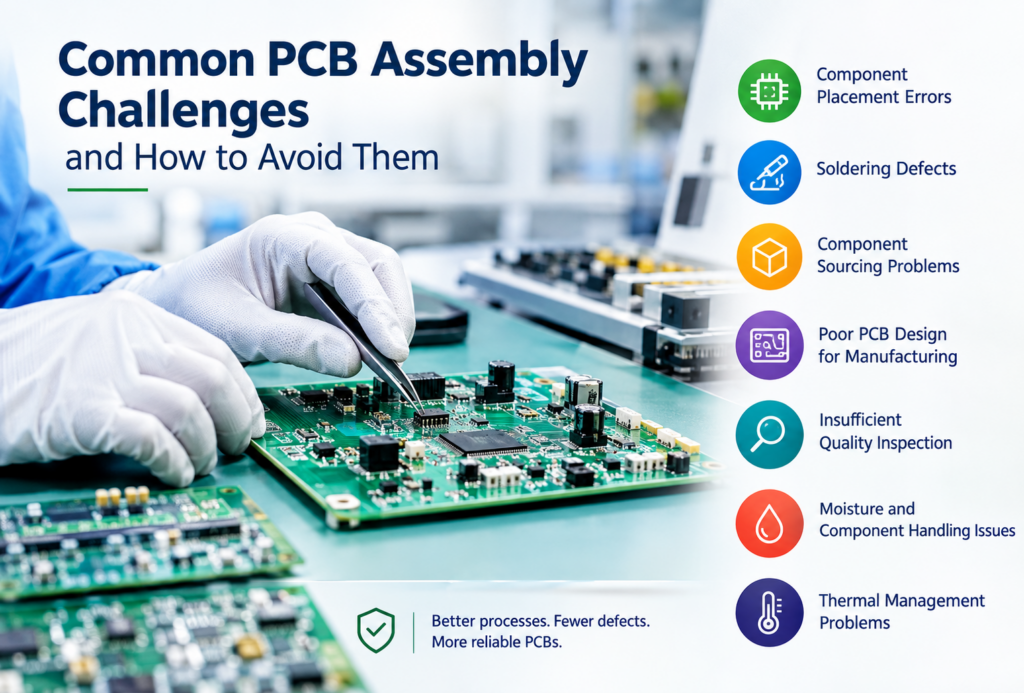
Printed circuit boards are at the heart of most modern electronic products. From consumer devices and industrial equipment to medical electronics and communication systems, reliable printed circuit board assembly plays an important role in how well a product performs.
However, getting a PCB from design to a fully assembled and functional board is not always straightforward. Component placement issues, soldering defects, sourcing problems, and inspection gaps can affect quality, production time, and overall costs.
Understanding these common challenges early can help manufacturers and product developers prevent avoidable problems and build more reliable electronics.
1. Component Placement Errors
Component placement is one of the most important stages of PCB assembly. Even a small placement mistake can affect the board’s electrical performance or make the final product difficult to assemble.
Incorrect orientation, misplaced components, or insufficient spacing may result from design errors or problems during production setup.
How to Avoid It
Before production begins, review the PCB design and assembly files carefully. Make sure component locations, orientations, footprints, and reference designators are accurate. Automated placement equipment and proper inspection procedures can also help identify placement problems before they become larger production issues.
2. Soldering Defects
Soldering problems are among the most common challenges in electronic assembly. Issues such as solder bridges, insufficient solder, cold solder joints, and excessive solder can lead to intermittent connections or complete circuit failure.
These defects may not always be visible without proper inspection.
How to Avoid It
Use appropriate soldering profiles and maintain equipment regularly. The soldering process should be matched to the board design and components being used. Automated optical inspection (AOI) and other quality-control methods can help detect defects before the assembled boards move to the next stage.
3. Component Sourcing Problems
The availability of electronic components can change quickly. Obsolete parts, supply shortages, long lead times, and unexpected price increases can delay production.
Choosing components without considering long-term availability can create problems later, especially for products that need to remain in production for several years.
How to Avoid It
Work with an experienced pcb assembly supplier that can help identify reliable component sources and suitable alternatives. It is also useful to check component availability during the design stage instead of waiting until production is ready to begin.
Where appropriate, engineers can consider approved alternative components that meet the required electrical and mechanical specifications.
4. Poor PCB Design for Manufacturing
A PCB may work correctly in theory but still present difficulties during physical production. Tight component spacing, inaccessible solder joints, unsuitable footprints, or complicated board layouts can increase assembly complexity.
This is why design and manufacturing teams need to work together rather than treating assembly as a completely separate step.
How to Avoid It
Use Design for Manufacturing (DFM) principles during the development process. A DFM review can identify potential manufacturing issues before boards reach production. Early design feedback can reduce rework, unnecessary expenses, and production delays.
5. Insufficient Quality Inspection
Not every assembly defect can be identified through a simple visual inspection. Some problems may involve hidden solder joints, component values, electrical connections, or manufacturing tolerances.
Skipping or reducing inspection to save time can result in defective boards reaching the next production stage.
How to Avoid It
A suitable inspection strategy should be based on the board’s complexity and application. Depending on the project, this may include AOI, X-ray inspection, electrical testing, functional testing, or manual inspection.
The goal is not simply to find defects but to identify problems early enough to prevent repeated production issues.
6. Moisture and Component Handling Issues
Certain electronic components are sensitive to moisture and improper storage. If moisture-sensitive components are not handled correctly, they may experience problems during high-temperature processes such as reflow soldering.
Improper handling can also lead to contamination, physical damage, or component mix-ups.
How to Avoid It
Follow recommended storage and handling procedures for sensitive components. Keep materials properly labeled and organized, and maintain appropriate environmental conditions wherever required.
Good material management is a small operational detail that can have a significant effect on assembly quality.
7. Thermal Management Problems
Electronic components generate heat during operation. If the PCB design does not provide adequate thermal management, excessive heat can affect component life, reliability, and overall product performance.
Thermal problems may become especially important in high-power or continuously operating electronic equipment.
How to Avoid It
Consider heat-generating components during the PCB design stage. Proper copper areas, thermal vias, heat sinks, component positioning, and appropriate materials can help manage heat more effectively.
Thermal requirements should be evaluated according to the actual operating conditions of the finished product.
8. Communication Gaps During Production
PCB projects often involve designers, engineers, purchasing teams, assembly specialists, and testing personnel. When information is unclear or changes are not communicated properly, mistakes can occur.
For example, using an outdated Bill of Materials (BOM) or assembly drawing can result in incorrect components being installed.
How to Avoid It
Maintain clear and controlled documentation throughout the project. Changes to the BOM, Gerber files, assembly drawings, or component specifications should be communicated and approved before production.
Choosing a responsive pcb assembly manufacturer can also make project communication easier, particularly when technical questions need quick clarification.
9. Prototype-to-Production Issues
A prototype that works successfully does not always guarantee a smooth transition to larger-scale manufacturing. Production volumes introduce additional considerations such as material availability, assembly speed, process consistency, and repeatability.
A design may need minor adjustments before it is ready for consistent production.
How to Avoid It
Treat prototyping as an opportunity to identify and resolve manufacturing challenges. Review prototype results, inspect assembly quality, test performance, and make necessary design or process improvements before moving into higher-volume production.
This approach can reduce costly changes later in the manufacturing cycle.
10. Choosing the Wrong Assembly Partner
The capabilities of the company handling your assembly can directly affect product quality, delivery schedules, and communication. Not every provider has the same equipment, testing capabilities, sourcing network, or experience with different PCB technologies.
Selecting a provider based only on price can sometimes create additional costs through delays, rework, or quality problems.
How to Avoid It
When evaluating PCB assembly services, consider more than the quoted price. Look at manufacturing capabilities, inspection processes, component sourcing, production capacity, communication, quality systems, and experience with similar projects.
A reliable partner should be able to understand your requirements and provide practical feedback throughout the assembly process.
Why Quality Matters in PCB Assembly
PCB assembly is more than simply placing components onto a board. Every stage, from material sourcing and component placement to soldering, inspection, and testing, contributes to the reliability of the finished product.
Working with an experienced provider of printed circuit board assembly services can help businesses establish consistent processes and reduce avoidable manufacturing problems. The right approach can also make it easier to scale a product from early prototypes to regular production.
How Absolute Electronics Services Supports PCB Assembly
Absolute Electronics Services focuses on helping businesses manage their electronic assembly requirements with attention to quality, consistency, and production needs. From component sourcing and assembly to inspection and testing, having a structured process helps reduce common manufacturing issues and keep projects moving efficiently.
The right assembly partner can also provide useful feedback when design, component, or manufacturing concerns appear during production. This collaboration can help businesses address problems earlier and improve the overall reliability of their products.
Conclusion
PCB assembly challenges can occur at almost any stage of the manufacturing process, but many of them can be prevented through careful planning, accurate documentation, proper material handling, effective inspection, and good communication.
Whether you are developing a prototype or preparing for ongoing production, selecting the right manufacturing partner and establishing quality-focused processes can make a significant difference. By addressing potential problems before they reach the production line, businesses can reduce rework, control costs, and produce more dependable electronic products.
The goal of successful PCB assembly is not simply to complete a board, it is to create a consistent manufacturing process that supports the quality and performance expected from the final product.